Work · Fortune 150 E-Commerce
Enterprise AI Platform
I led the enterprise AI platform effort at a Fortune 150 e-commerce company. The work was equal parts infrastructure, workflow design, and culture, and it drove measurable productivity gains with real adoption — the governance groundwork an org needs before agents can act on its systems.
Project Overview
I led the Enterprise AI Initiative: not just deploying tools, but reshaping workflows, building critical infrastructure, and changing how people actually work. The work spans AI IDE rollout, secure gateways into internal systems, observability for millions of LLM requests, and frameworks that make engineering tasks programmatically accessible to agents.
The Challenge
We ran into the usual mess when adopting AI at enterprise scale: fragmented tool adoption with no centralized strategy, security concerns about AI touching internal systems and codebases, no visibility into usage, costs, or effectiveness, workflows never designed for AI, cultural resistance, and no framework for measuring productivity gains or ROI. This was never going to be solved by buying licenses — we had to build infrastructure, change processes, and shift culture.
What We Built
AI IDE Deployment
I led the enterprise-wide rollout of AI coding assistants to thousands of engineers: a phased adoption strategy with success metrics, custom integrations with the company's development environment, training and best-practices documentation, and feedback loops for continuous improvement. We reached 90%+ adoption within six months.
Centralized MCP Gateway
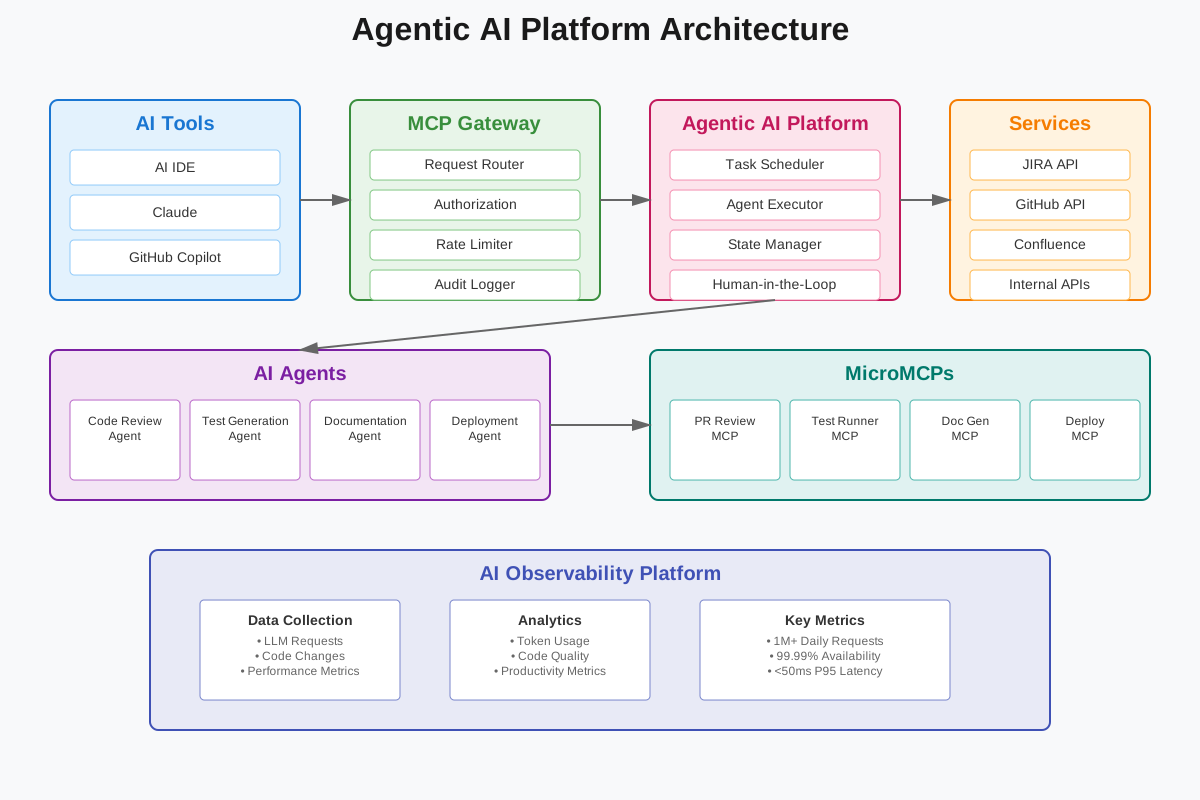
The foundation was a secure, audited gateway for AI tools to reach internal systems: a TypeScript-based proxy with fine-grained access controls, OAuth integration, request signing, and comprehensive audit logging, connected to JIRA, Confluence, GitHub Enterprise, and internal APIs. It is low-latency and highly available, with a full audit trail for security and compliance. The gateway became the central integration point for everything that followed — AI tools working with internal data within security standards, and later the agent platform and MicroMCPs.
AI Observability Platform
To make adoption legible, we built observability over the whole stack: real-time processing of 1M+ LLM requests daily, token usage and cost attribution by team and project, quality metrics for AI-generated code (test coverage, review feedback), productivity analytics showing time saved, and anomaly detection for unusual usage. This visibility drove data-driven decisions about tool investments and training.
Agent Orchestration and Work-as-Code
On top of the gateway we built infrastructure for multi-step AI workflows: a scheduler, agent executor, and state manager running agents for code review, test generation, documentation, and deployment, with human-in-the-loop approvals and notifications through Slack, parallel execution, and real-time progress monitoring. Agents call specialized "MicroMCP" servers — PR review, test running, doc generation, deployments, task tracking, analytics — for specific subtasks.
The work-as-code framework made this extensible: micro-MCP servers per engineering domain, standardized interfaces for common operations, an SDK for teams to expose their own workflows to AI, patterns for safe, auditable AI interactions, and a "serverless" approach to AI tool integration.
Results & Impact
- Measured productivity gains: consistent reduction in time for common engineering tasks
- Thousands of Engineers Enabled: Near-universal adoption across engineering
- Significant Annual Savings: Through improved efficiency and reduced development time
- Large reduction in boilerplate work: AI handling repetitive coding tasks
- Faster PR reviews: AI-assisted code review and testing
- Cultural Transformation: AI now integral to engineering workflows
Key Innovations
Security-first architecture. A zero-trust model for AI tool access to internal systems, with a granular permission system based on user, tool, and resource, real-time monitoring and anomaly detection, and compliance-ready audit trails for every AI interaction.
Measurement framework. Productivity metrics tied to business outcomes, quality indicators for AI-generated code, team-level adoption dashboards, and ROI calculations for tool investments.
Cultural change management. Executive alignment and sponsorship, a champion program for early adopters, regular showcases of AI success stories, integration into engineering onboarding, and continuous education.
Technical Challenges Overcome
Enterprise scale meant a distributed architecture handling millions of daily requests, intelligent caching to reduce API costs, request prioritization for critical workflows, and fallback mechanisms for AI service outages. Integration complexity meant adapters for 20+ internal APIs and tools, translation layers between data formats, unified authentication across systems, and retry logic and error handling throughout.
Future Roadmap
The initiative continues to evolve: moving from AI assistance to autonomous task completion, fine-tuning LLMs on the company's codebase and patterns, predictive analytics to prevent engineering bottlenecks, extending AI tools to product, design, and operations, and sharing our frameworks with the open source community.
My Role & Leadership
As AI Architect leading the initiative, I defined the technical strategy and architecture for AI adoption, led cross-functional teams across engineering, security, and operations, drove executive alignment and secured funding, mentored engineers on AI integration best practices, represented the company at AI conferences and industry forums, and collaborated with AI vendors on enterprise features.
Technologies Used
- Languages: TypeScript, Python, Go
- AI Tools: Various AI IDEs, Claude, GPT-4, GitHub Copilot
- Infrastructure: Kubernetes, AWS, Terraform
- Observability: Datadog, Grafana, Custom Analytics Platform
- Frameworks: MCP (Model Context Protocol), LangChain, Custom SDKs
Lessons Learned
Infrastructure and security must come before tool deployment, and measurement and visibility are crucial for adoption. Cultural change is as important as technical implementation: start with high-value, low-risk use cases to build confidence, invest heavily in training and documentation, and build for extensibility — the AI landscape changes rapidly.